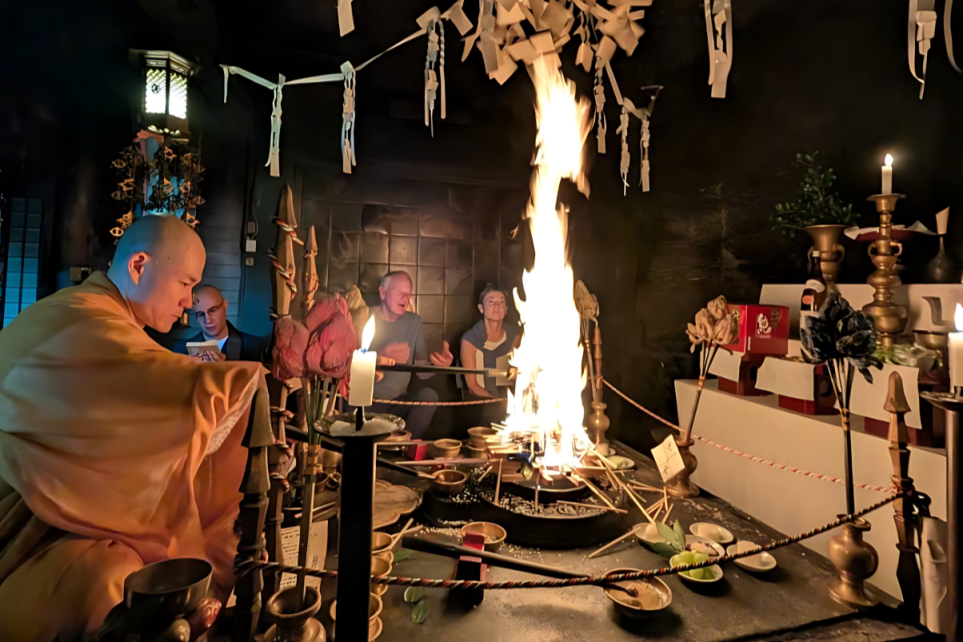
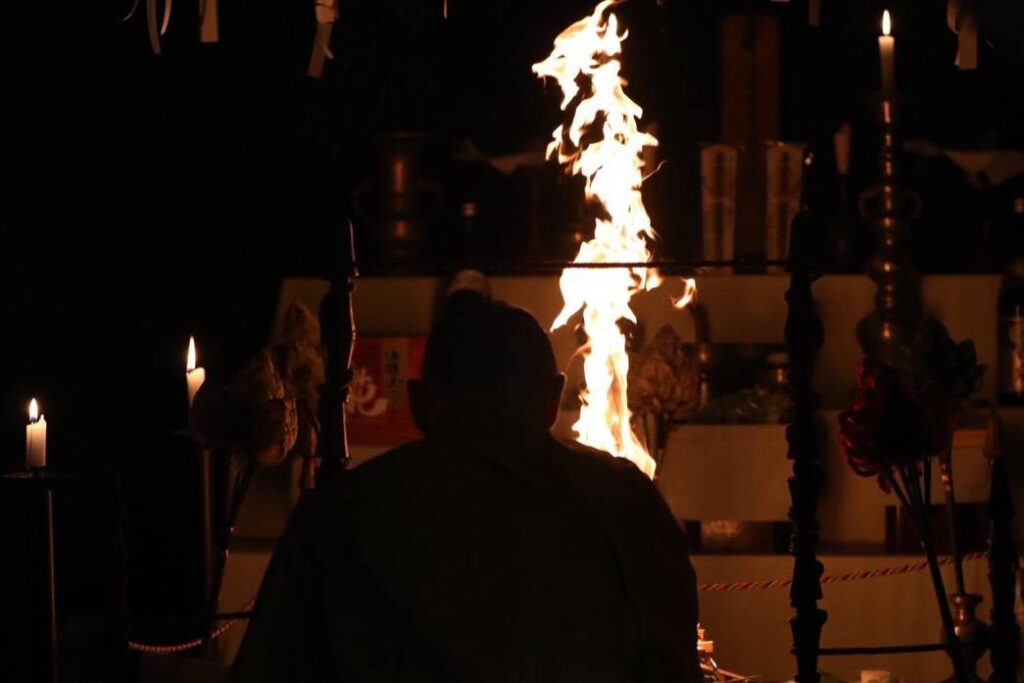
Crackling flames cast an orange glow on the fearsome Buddha before the altar as the smell of fragrant smoke fills your nostrils. The pounding of the taiko drum makes the entire temple vibrate, mingling with chanting voices. The priest seated at the altar rhythmically tosses offerings into the sacred flame, softly intoning incantations as he does.
The Goma, or Fire Offering Service, an iconic ritual of Shingon “Esoteric” Buddhism, is an impressive multisensory experience, one that has captivated and inspired temple visitors, both Japanese and otherwise, for centuries. This article introduces the ritual’s context and meaning, and offers a few points of orientation for those planning to participate in a Goma during their time in Shikoku.
Esoteric Origins
The Goma is a ritual of Mikkyo, the “Esoteric Teachings,” a form of Buddhism centered on meditative rites transmitted directly from teacher to student. This tradition was brought from China to Japan by Kūkai, the saint at the heart of the Shikoku 88 Temple Pilgrimage.
Esoteric Buddhist practice engages the practitioner’s entire being through the “Three Mysteries” of body, speech, and mind. The body is engaged through ritual hand gestures called mudra, speech through sacred phrases called mantra (in Japanese, shingon), and the mind through visualizations of enlightened beings and their realms. According to Shingon teachings, these practices lead to sokushin jōbutsu, “becoming a Buddha in this very body.”
The Goma is a ritual of Mikkyo, the “Esoteric Teachings,” a form of Buddhism centered on meditative rites transmitted directly from teacher to student. This tradition was brought from China to Japan by Kūkai, the saint at the heart of the Shikoku 88 Temple Pilgrimage.
Esoteric Buddhist practice engages the practitioner’s entire being through the “Three Mysteries” of body, speech, and mind. The body is engaged through ritual hand gestures called mudra, speech through sacred phrases called mantra (in Japanese, shingon), and the mind through visualizations of enlightened beings and their realms. According to Shingon teachings, these practices lead to sokushin jōbutsu, “becoming a Buddha in this very body.”
Each esoteric ritual centers on a specific deity whose form embodies an aspect of enlightened wisdom or compassion. The central figure of the Goma is Fudō Myōō, “The Unmoving One.” His fierce appearance—wrathful, wreathed in flame, sword in hand—often surprises those whose image of Buddhism is a placid, minimalist tradition. Yet Fudō represents unwavering wisdom and the Buddhas’ “tough love,” cutting through delusion and consuming the selfish desires that give rise to suffering. This transformative fire lies at the heart of the Goma ritual.
This Afterparty Is Lit
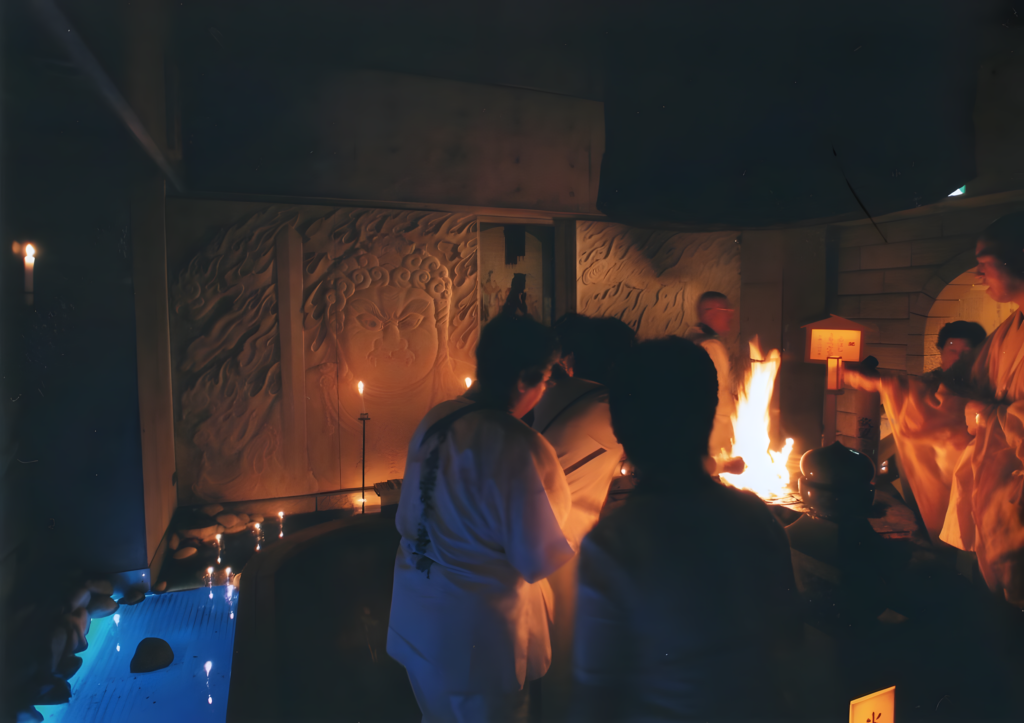
The goma and other esoteric rituals are rooted in an ancient Indian tradition of welcoming honored guests. First, the practitioner prepares the altar and arranges offerings. The deity is then formally invited, their arrival marked by the ringing of a bell. Once present, the practitioner makes a sequence of offerings.
While the fiery Goma is the most visually dramatic of Shingon rituals, it is in fact an afterparty—an expansive series of offerings not only to Fudō, but symbolically to all deities throughout the universe. The hearth at the center of the altar is visualized as the deity’s mouth, into which offerings such as oil, rice, and incense are poured in ritual order.
The goma and other esoteric rituals are rooted in an ancient Indian tradition of welcoming honored guests. First, the practitioner prepares the altar and arranges offerings. The deity is then formally invited, their arrival marked by the ringing of a bell. Once present, the practitioner makes a sequence of offerings.
While the fiery Goma is the most visually dramatic of Shingon rituals, it is in fact an afterparty—an expansive series of offerings not only to Fudō, but symbolically to all deities throughout the universe. The hearth at the center of the altar is visualized as the deity’s mouth, into which offerings such as oil, rice, and incense are poured in ritual order.
At the center of the ceremony, the priest offers 108 wooden sticks, representing the 108 desires believed to cause human suffering. This number is calculated by multiplying the six senses (the five senses plus consciousness), by three emotional states (like, dislike, and neutrality), by two conditions (pure and impure), and finally by the three dimensions of time (past, present, and future):
6 × 3 × 2 × 3 = 108.
In other words, everything that has ever caused, or could ever cause, suffering is offered into the fire, where it becomes fuel for the flame of wisdom.
Throughout the ritual, chanting is often led by an assisting priest, accompanied by drums. This may include the Heart Sutra, one of Japanese Buddhism’s most beloved texts, or the mantra of Fudō himself. Participants are encouraged to chant along as they are able, creating an intense, shared atmosphere that engages the senses and draws everyone into the ritual together.
After the 108 sticks are offered, participants may offer goma-gi, wooden tablets inscribed with personal prayers or aspirations, to the sacred fire. Having honored Fudō with such abundant offerings, this is the moment to entrust him with obstacles, hopes, and intentions.
The ritual concludes as the deity is respectfully sent off, again marked by the ringing of a bell. When a Goma is held for a specific purpose, temples may prepare an ofuda, a consecrated wooden talisman, which participants can take home and enshrine as a reminder of the ritual and its intentions.
Experiencing Goma in Shikoku
Goma rituals remain a living practice at temples across Shikoku, often held on auspicious dates or as part of seasonal observances. When attending a Goma with Shikoku Tours, guests are guided through the experience with clear explanation and cultural sensitivity, allowing them to participate with confidence and respect while fully absorbing the power, intensity, and meaning of this ancient ritual.